Every year, the Republic of the Marshall Islands commemorates Nuclear Victims Remembrance Day on March 1, which marks the 72nd anniversary of the Castle Bravo nuclear test conducted by the U.S. in Bikini Atoll. This year also marks 80 years since the U.S. began nuclear testing in the Marshall Islands. Between 1946 and 1958, the U.S. military conducted 67 nuclear tests in the Marshall Islands, as part of their efforts to develop the U.S. nuclear arsenal. These tests left several atolls heavily contaminated with radioactive fallout and waste and largely uninhabitable, leading to the displacement of islanders.
Many Marshallese people reside in the U.S. today as a result of this displacement, which is also being driven by the ongoing rise in sea levels driven by climate change. Their migration is facilitated by the U.S. Compact of Free Association, which allows citizens of the Republic of the Marshall Islands, as well as citizens of the Federated States of Micronesia and the Republic of Palau, to legally migrate, work, and reside in the U.S. as “nonimmigrant aliens.” Marshallese communities have since formed across the U.S.—from Arkansas to Oregon to Hawaii— and are planning activities to commemorate U.S. nuclear testing in the Marshall Islands and its ongoing environmental, health, and cultural consequences for the islanders.
In March 2024, during the early phase of the Mapping Nuclear Legacies project, I travelled to Springdale, Arkansas to attend Nuclear Legacy Week, a multi-day conference organized by the Marshallese Educational Initiative. MEI is a nonprofit organization based in Springdale, which is home to the largest Marshallese community outside of the Marshall Islands. The Republic of the Marshall Islands has a consulate general there. Attending the conference was a deeply moving and personally transformative experience. The conference addressed the need for communities affected by nuclear weapons development to have more agency in shaping the narrative around nuclear weapons and to foster solidarity. It explicitly created space and time exclusively for members of these communities and prepared all conference participants to respect this intention. After the conference, I refocused my project on the legacies of U.S. nuclear weapons development and their role in grassroots efforts to address nuclear weapons and waste issues across the country. As this website shows, I have also developed several collaborations with some of these affected communities.
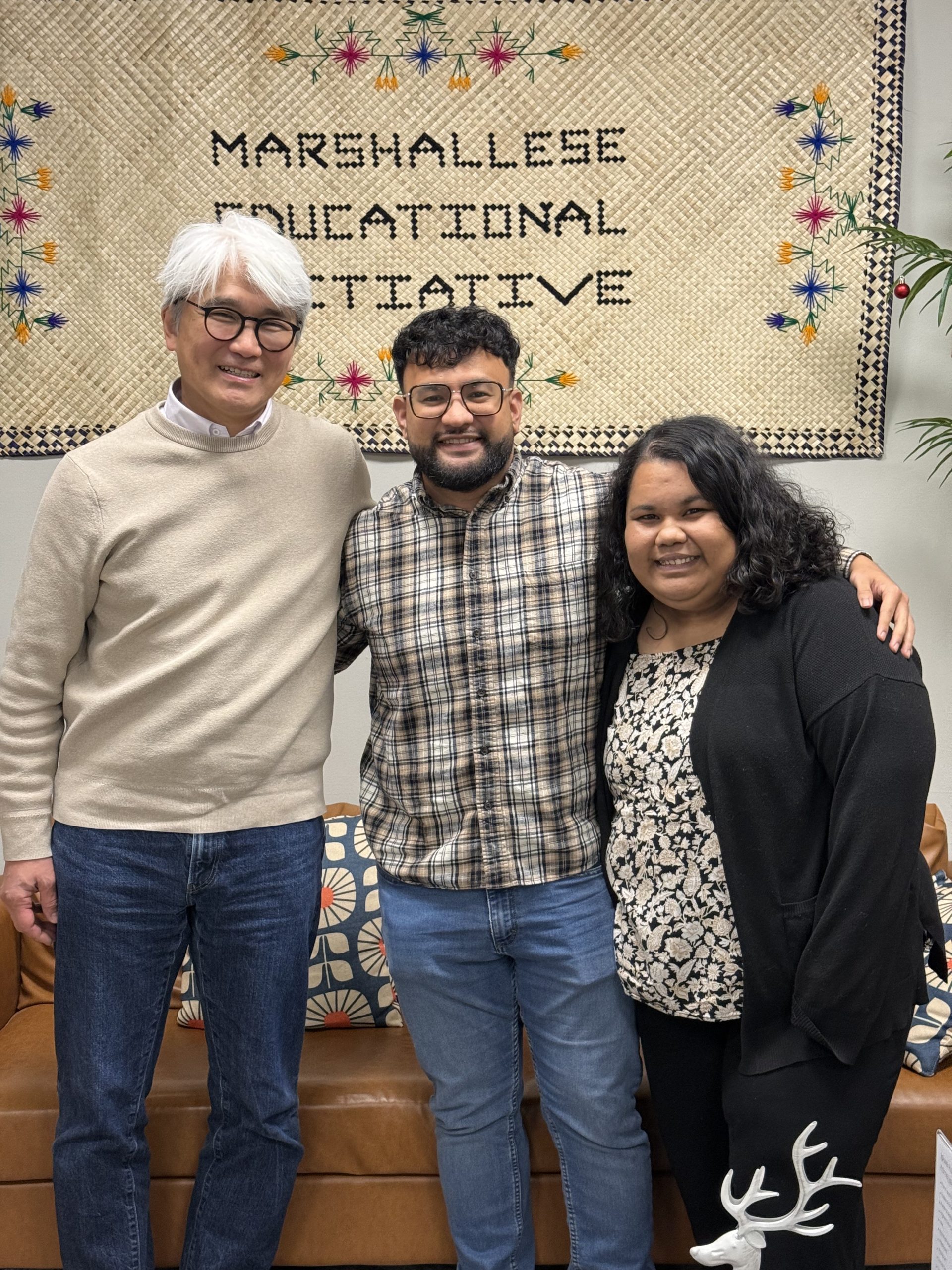
MEI is a leading force within the Marshallese community in Springdale. They address a broad range of issues facing the community, including domestic violence, healthcare access, and the legacy of U.S. nuclear testing. MEI began with an event organized by April Brown, a history professor at NorthWest Arkansas Community College. Brown co-founded MEI with Jessica A. Schwartz, a cultural anthropologist who has conducted ethnographic research in the Marshall Islands and Marshallese diaspora communities (See Jessica Schwartz’s 2021 book Radiation Sounds: Marshallese Music and Nuclear Silences). Benetick Maddison, a Marshallese local, subsequently joined the initiative and is now the executive director. Along with other young local Marshallese leaders, such as Marcina Langrine and Matthew John of the local Marshallese band Mark Harmony, Maddison has traveled around the country and the world, calling attention to the ongoing impact of U.S. nuclear testing on the Marshall Islands. What follows are excerpts from my recent conversation with Maddison and Brown about the origins and future ambitions of MEI. The conversation was recorded on February 5, 2026. This transcript has been lightly edited for length and clarity.
Miyazaki: How did the Marshallese Educational Initiative begin?
Brown: I was the honors director here at [NorthWest Arkansas Community College], and we focused every spring on a different people and region of the world. In 2013, we focused on the Marshallese. That is where I met several [Marshallese] community members. I met Consul General Carmen Chung Gum. That’s also where I met Jessica Schwartz … It was so good, and it was information that I did not know. I was a little flabbergasted because I’m a historian, I have a PhD in history, and I knew that the United States conducted nuclear testing in the Marshall Islands. But I knew really nothing else other than that it happened. There are so many folks [from the Marshall Islands] living here, and yet it was just odd that I didn’t know more. At the time, you really didn’t hear about the Marshallese population unless they were in the newspaper, or that they were having some sort of cultural event or that somebody got in trouble.
With Jessica Schwartz, Brown founded the Marshallese Educational Initiative. Their goal was to address the Marshallese nuclear legacy locally. They received a grant from the Arkansas Humanities Council for an oral history project, which would prove consequential to the future of the initiative. The project involved interviews with 50 individuals, from elders to youth. Among them were the Consul General at the time, Carmen Chong Gum, as well as Marshallese elders Leton Beasha and Shine Benkim. Beasha spoke to navigation and canoe-building, and Benkim shared stories from World War II and songs from her native island of Jaluit. Maddison, who was a high school student at the time, joined the project then. In 2014, MEI organized a high-profile event at the Clinton Presidential Library in Little Rock to commemorate Nuclear Victims Remembrance Day. This was the first large event MEI organized to raise public awareness of the Marshallese nuclear legacy. MEI collaborated with local Marshallese elders as well as global Marshallese public figures, such as climate activist Tina Stege and Bikinian activist Nixon Jabas. Maddison also spoke at the event.
Miyazaki: Benetick, you joined the MEI in 2020 as a staff member and became the executive director of the MEI in 2022. What did you think about the MEI when it started?
Maddison: It was great to see that there was an organization collecting stories from the community, especially our elders. So that was a positive thing that I saw. And then of course, [the MEI organized] Nuclear Victims Remembrance Day at the Clinton Presidential Library in Little Rock in 2014.
Initially, however, MEI struggled to receive support for projects related to the nuclear legacy. In 2018, MEI received grants for local community training and education projects, particularly those related to preventing violence against women and from the U.S. Department of Interior’s Office of Insular Affairs (OIA) grant. Thanks to these grants, the Initiative was able to hire local Marshallese as staff members; Maddison was one of them.
During the subsequent pandemic, MEI grew exponentially and was able to serve the community, which had suffered considerably, through initiatives focusing on food insecurity, utilities, housing, education about disease prevention and vaccination. Their first grant, during lockdown, was to deliver food, and upon MEI’s suggestion, the Consul General convened a task force to guide prevention efforts. Additional grants and funds went to pay for funeral expenses, to purchase and distribute PPE, and to help people pay rent. Helping the community in these ways opened up new avenues to assist based on what was needed. MEI returned to its original goal of addressing the nuclear legacy and began to collaborate with the Nuclear Age Peace Foundation and other organizations dedicated to nuclear disarmament. A large, multi-year pandemic-related rescue grant received by MEI in 2023 enabled the organization to expand its nuclear disarmament work. Maddison began traveling to attend and speak at U.N. conferences. Through these global networks, MEI identified the need to establish a space where affected communities could collaborate in solidarity and “take back the narrative” surrounding nuclear weapons. MEI is also working closely with the Nuclear Truth Project to establish protocols for research involving affected communities.
Miyazaki: You say, “take back the narrative.” Could you please elaborate on what you mean by that?
Maddison: For a very long time, and even to this day, especially with older Marshallese, they’re still stuck with the information that the United States provided many decades ago. For example, many adults still believe that only four atolls are impacted, but the reality is that it was the entire country. We’re taking back the narrative by telling our community and the world, “Look, it’s the entire Marshall Islands that was exposed to nuclear fallout, not just Bikini, Utrik, Enewetak, and Rongelap.” But also, the nuclear legacy in general is shrouded in secrecy and misinformation for the benefit of the nuclear state that tested nuclear weapons. And there’s obviously still a lot that we need to learn about the nuclear legacy. I mean, we’re seeing health issues. For example, autism is such a big issue in the community … We do a lot of work raising awareness about the effect of nuclear legacy, but we also need to be the ones doing the research.
Under Maddison’s leadership, MEI is seeking to expand the scope of its exploration of nuclear legacy. Maddison envisions MEI evolving into a research institute with a museum, run by Marshallese for Marshallese, in collaboration with non-Marshallese experts who share this vision of nuclear legacy. The proposal defines the Institute as a “Marshallese-directed and community-led research and education hub focused on nuclear justice, health equity, cultural revitalization, and environmental resilience.” This holistic vision of work for repair and renewal, anchored in the expanded vision of nuclear legacy, is propelled by an underlying goal of the Marshallese reclaiming agency: “The Institute will restore agency to Marshallese communities in diaspora by directing and producing culturally grounded research, building a pipeline of Marshallese scholars, and establishing equitable partnerships that prioritize Marshallese voices and lived experiences.”
Since the 2024 conference, I have visited Springdale four times to interview people associated with MEI, local school district officials dedicated to educating young Marshallese, and Springdale Mayor Doug Sprouse. Springdale, home to the global headquarters of Tyson Foods, which originally attracted many Marshallese migrants seeking job opportunities in local chicken factories, is now a rapidly growing city with a more diverse economy. Each time I visit, the city’s main business district appears different, with new developments and constructions. The local Marshallese population suffered greatly during the COVID crisis and continues to face challenges, including language barriers, prejudices, and institutional obstacles stemming from the “nonimmigrant alien” status of many in the community. However, their increased civic engagement will inevitably shape the future of this bustling city in northwest Arkansas. In November 2024, Mayor Sprouse observed that young Marshallese are beginning to thrive in the city. In his view, over the next decade, Springdale will see more Marshallese serving in civic leadership positions: “Our prayer is that we continue to be welcoming… My hope is that in ten years, we will have a Marshallese city councilor and a Marshallese planning commissioner.” (Interview with the author, Nov. 19, 2024).
MEI envisions a transformative future for the local Marshallese diaspora community. This year, MEI is planning a national and global tour to raise awareness of the Marshallese nuclear legacy through music with the Springdale-based Marshallese band Mark Harmony. The proposed research institute aims to redefine how the Marshallese nuclear legacy is understood locally, nationally, and globally. MEI and the outreach efforts of the Marshallese community represent the energy, resilience, and initiative of local Marshallese youth and Springdale today.