
War leaves many wounds unhealed, and memories of violence and violation persist. Reconciliation is not an easy task. It is a long and winding process. The postwar relationship between the United States and Japan is a case in point. Although the two countries have long been strategic allies, the question remains whether they have truly achieved reconciliation. At the citizen level, the focus of this project, reconciliation is still a work in progress. This suggests that reconciliation is an ongoing process requiring each person’s initiative, dedication, and openness. Here I offer two episodes that continue to inspire me.
From Pearl Harbor to Nagasaki
On August 9th, after attending the official 81st commemoration of the atomic bombing of Nagasaki, I attended an event featuring a dialogue between two women: Chiyoko Motomura (87) and Dorinda Makanaõnalani Nicholson (90). As children, they survived the U.S. atomic bombing of Nagasaki and the Japanese attack on Pearl Harbor, respectively. Earlier that day, Motomura delivered her “Pledge for Peace” speech at the official commemoration ceremony, in which she proclaimed that “peace means protecting life.” She met Nicholson in Honolulu during her peace promotion tour of the U.S. last fall. Nicholson, who published her memoir Pearl Harbor Child in the late 1990s, traveled from her current home in Kansas City, Missouri, to Nagasaki alone for this reunion on August 9.
At the event, Nicholson shared her experience of the Pearl Harbor attack as a child—offering a rare glimpse into the civilian experience on the ground—and recounting her earlier efforts to reconcile with one of the Japanese pilots who participated in the Pearl Harbor attack. Motomura then shared her experience of the atomic bombing, describing how her grandmother saved her life by shielding her with her own body, only to later die from the injuries she had sustained. Motomura said that she has carried, and will continue to carry, the burden of having been given life at the expense of her grandmother’s.
During the subsequent dialogue, Motomura described experiencing a “dissolution” (yokai) of her resentment toward Americans when she met Nicholson in Honolulu last fall. Motomura and Nicholson both mentioned experiencing a moment of mutual recognition upon meeting. Motomura knew Nicholson did not speak Japanese, so she was nervous to meet. However, she experienced firsthand the importance of in-person dialogue—of looking each other in the eye. In response, Nicholson said, “The first time I met you, I looked into your eyes. It was like looking into your spirit and my spirit, and [I felt] we had always been friends.” At the end of the dialogue, Nicholson spontaneously suggested performing a hula dance to Andy Williams’ “To Your Sweetheart, Aloha” like she did when they met for the first time.
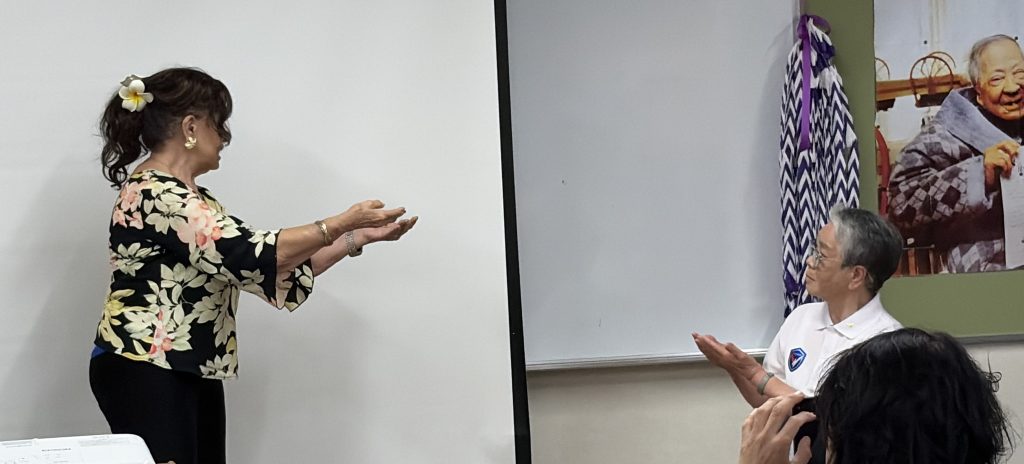
Such spontaneous moments and expressions of friendship and love are difficult to capture retrospectively and danger of sounding naïve, but during these fleeting moments, I caught glimpses of the deepest level of reconciliation, or at least the possibility of it. At the event on August 9 Motomura and Nicholson rehearsed what the two had seen through each other’s eyes in Pearl Harbor last December for the audience. Perhaps the only way to recapture glimpses of the possibility of reconciliation is to be open to it in each encounter.
From Pearl Harbor to Hiroshima
The event on August 9 reminded me of my own encounter with Tom Leatherman, Superintendent, Pearl Harbor National Memorial, in December 2024. On Dec. 7, 2024, I attended the commemoration of the Pearl Harbor attack at the Pearl Harbor National Memorial for the first time. Two days before, I visited Leatherman and learned of his role in the establishment of the sister park relationship between the Hiroshima Peace Park and the Pearl Harbor National Memorial. I was so inspired by his dedication to peace that I visited him again in March 2025 for a formal interview.
The sister park relationship, established in June 2023, has been controversial, particularly in Hiroshima, where some feared that it would hurt the need for the U.S. to acknowledge its responsibility for the use of the atomic bomb and the broader inhumanity of nuclear weapons. Through Leatherman, I gained a different perspective on the relationship.
Tom Leatherman arrived as superintendent in October 2021. Upon his arrival, he began to think about what more could be done to build on the historic visits of U.S. President Barack Obama to Hiroshima and Japanese Prime Minister Shinzo Abe to Pearl Harbor. Leatherman started exploring the possibility of creating a sister park relationship between the two sites:
Leatherman: The National Park Service engages in a lot of sister park relationships all over the world. And I would say most of those relationships are sort of in name only — we sign a piece of paper that says we’re going to work together, and then we don’t really do anything with it. But I didn’t want to just do a relationship to sign a piece of paper. I wanted to actually do something.
Two other individuals played pivotal roles in advancing Leatherman’s idea: Wayne Miyao, a well-connected Honolulu civic leader with close ties to Hiroshima Mayor Matsui Kazumi, and Richard May, a career diplomat at the U.S. Consulate in Osaka with deep connections to Hiroshima city officials. The three of them worked tirelessly together, and May convinced the then-U.S. Ambassador to Japan, Rahm Emanuel, of the importance of the relationship. Although the partnership was not formalized at the G7 Summit in Hiroshima in May 2023 as planned, due to President Zelensky’s unexpected appearance, it was later finalized in Tokyo on Jun. 29, 2023, by Mayor Matsui and Ambassador Emanuel.
Leatherman was aware that the relationship would be controversial; he even received pushback from some of his own friends:
Leatherman: When we think about promotion of peace, who shouldn’t be involved in that conversation? Is there somebody? Because I would argue that we want everyone involved in the conversation about the promotion of peace. And if we can get a site like Pearl Harbor to work towards the promotion of peace, we’re better off than we were before.
According to Leatherman, some people in Hiroshima were concerned about the Pearl Harbor National Memorial’s perceived connection to the military. Language refinements to the agreement addressed this concern and ensured that the agreement focuses on promoting peace.
Leatherman praised Mayor Matsui’s leadership in this process. He knew the mayor had faced criticism for supporting this initiative:
Leatherman: The mayor has taken a lot of flak for this. He had to really go out on a limb to sign this agreement — that showed a lot of power for me, at least. It demonstrated leadership in the promotion of peace, because he was doing something he felt was going to help promote peace, but wasn’t popular with other people who might think that’s not a good way to go.
When the mayor visited Pearl Harbor, he shared a personal philosophy that Leatherman says he will carry with him:
Leatherman: He said, “It’s my feeling that we were put on this planet to make it a better place when we leave. And that’s how I move through life, and that’s what I feel like we did here by signing this agreement and working together to promote peace.” And he said — I think quite humbly — “I think you were the right person to help us do that.”
Since the agreement was signed, the relationship has already generated tangible exchanges. In August 2024, two hibakusha from Hiroshima visited Pearl Harbor and gave testimonies to packed audiences in the visitor center theater.
Leatherman: They gave their testimonials in our theater for visitors. We had a full 150-person theater, twice, listening to their testimony. That’s pretty powerful. And that wouldn’t have happened, likely, if we hadn’t made a connection between the [two] sides. We have an opportunity to use our relationship to help more people understand the history and the importance of promoting peace.
Leatherman’s week-long visit to Hiroshima in August 2023 directly influenced the ongoing redesign of the Pearl Harbor National Memorial’s visitor experience. In particular, he was struck by how the Hiroshima National Peace Memorial Hall for the Atomic Bomb Victims memorializes each victim.
Leatherman: The most powerful place I visited was the Museum to the Atomic Bomb Victims, where there’s a 360-degree image of ground zero made up of 140,000 tiles, one for each victim of the A-bomb. It was very emotional. It created an understanding of the differences between these sites — not just historically, but in how we memorialize people, how we honor those whose lives were lost. Those 1,177 men had lives. They were from somewhere. Their story is important not to be forgotten. If all we’ve done is show you their names on a marble slab, what are we actually doing to help people remember who they were? We are going to find a way to make those stories come alive — to help people understand these aren’t just 1,177 names on a wall, but individuals whose lives were lost and changed forever.
His visit to Hiroshima also left him personally transformed in ways he had not anticipated. He had expected complexity, but he found something entirely different:
Leatherman: I was not prepared to experience such a unified sense of the promotion of peace. To a person, the feeling there was not a feeling of animosity or hatred towards someone, but a feeling that we need to do everything we can to help people understand this should not happen to anyone ever again. That’s what I walked away with when I came there. And I was not expecting that.
In Hiroshima, Leatherman felt a shared sense of responsibility for peace, both big and small. A brief conversation with the landscaping volunteers who proudly maintain the Peace Park grounds confirmed this sense of collective dedication.
Leatherman: I thought to myself — that is not what I would experience here [in Pearl Harbor]. We don’t have this sort of unified feeling that we all have a role to play in [promoting peace].
He additionally came home with a historical fact that he had never been taught:
Leatherman: I can almost guarantee you that 99% of the people in this country do not know this, but there were American prisoners of war in Hiroshima when the bomb was dropped, that we knew were there. Just that piece of the story alone would make a whole bunch of people question our government’s intentions. As you learn more about history, you learn more how complex it is. But when you share a more complete history, people have a lot more empathy for those who were affected on both sides.
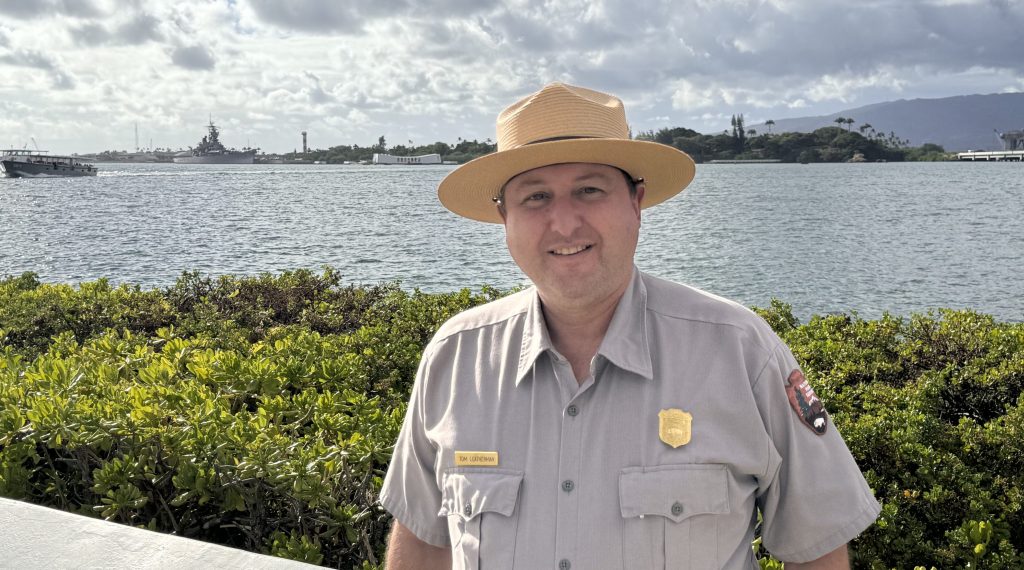
In our conversation, I was moved, not by the behind-the-scenes information about the sister park relationship or its institutional impacts, but by Leatherman’s openness to seizing opportunities to champion peace and reconciliation as a common goal, as well as his willingness to be inspired by what he heard, saw, and experienced.
These two episodes differently explore the complex historical connections between the Japanese attack on Pearl Harbor and the U.S. atomic bombings of Hiroshima and Nagasaki on a personal level. Each episode demonstrates the important role that distinct encounters, individual initiatives, and personal relationships play in keeping peace and reconciliation visible as ongoing commitments.